
GARVEY LIVES!!! GARVEY LIVES!!! GARVEY LIVES!!!
MOSIAH LIVES!!! MOSIAH LIVES!!! MOSIAH LIVES!!!
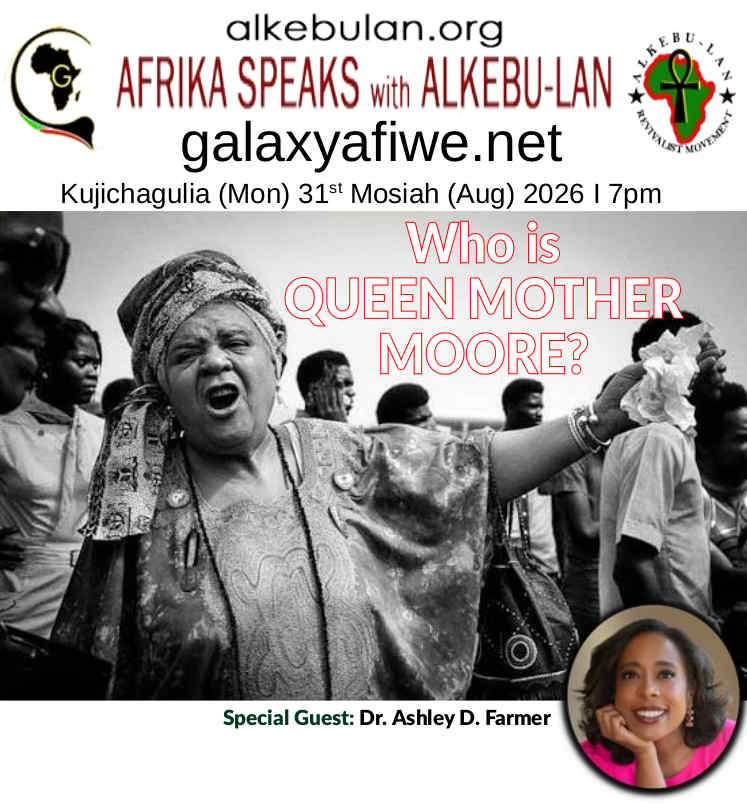
As we bring our Mosiah season to a close we highlight a giant that was a leader of at least “three generations of Black political activity, and cultural re-awakening in the United States” and beyond – Queen Mother Moore. (1)
Audley Moore was born in Louisiana on July 27th 1898 and passed into the Ancestral realm on May 2nd 1997 having spent almost eight decades on Liberation Road. “Already in struggle” when she joined the UNIA-ACL in 1922 after being introduced to the organisation by her younger sister Eloise, to many she is “one of the most revered figures in twentieth-century Black nationalism, Pan-Africanism, and Communism, who was critical to launching the modern reparations movement and Black Power.” (2)
The story of Sista Powa, Afrikan women in the liberation movement should be a storied one particularly in the UNIA-ACL where women ran some of the most dynamic auxiliaries like the Black Cross Nurses, but it has not always been adequately documented. Some notable examples include Jeannette Smith-Irvin’s 1989 Footsoldiers of the Universal Negro Improvement Association. Heretwo of the seven interviewees were women (Mama Amy Jacques Garvey and Mama Ruth Smith). Amy Jacques Garvey had her own dedicated volume in Ula Yvette Taylor’s The Veiled Garvey: The Life and Times of Amy Jacques Garvey published in 2002. Six years later Queen Mama Nzingha Assata released Women in the Garvey Movement focusing on the likes of Madam de Mena, Henrietta Vinton Davis, Lillian Galloway, Amy Ashwood and Amy Jacques Garvey. Things have picked up again in more recent years with Keisha N. Blain’s Set the World on Fire: Black Nationalist Women and the Global Struggle for Freedom that came out in 2018. Last year saw two significant publications in Natanya Duncan’s An Efficient Womanhood: Women and the Making of the Universal Negro Improvement Association, which developed on her 2009 doctoral thesis. The other was Queen Mother: Black Nationalism, Reparations, and the Untold Story of Audley Moore by Ashley D. Farmer which came out in November. (
Many would argue that a comprehensive biography of Queen Mother Moore is well overdue. Although she was known, loved and guided by successive generations of freedom fighters, it is not clear how familiar today’s activists are with her legacy.
The key aspect about Queen Mother Moore is that she was an organisation woman staying in the UNIA-ACL until the early 1930s having relocated to New York following Marcus Garvey’s deportation. She then moved to the Communist Party due in large part to their work on the Scotsboro Boys case. However she broke from the Communists in 1950, believing that white leftists were insincere in their commitment to Black freedom. Moving back to Louisiana she formed the Sons and Daughters of Ethiopia an auxiliary of the UNIA’s New Orleans Division in 1954. In 1957 she formed, with her sister Eloise the Universal Association of Ethiopian Women (UAEW) in New Orleans, an organisation committed to “decolonizing Black minds, community feminism, and African liberation.” (4)
Here she also began articulating demands for reparations for slavery and Jim Crow and its effects:
“So, a thing that I always feel terrible about, the rape of the Black women, every one almost, almost every one of us was raped. Women and young girls. And so this complexion that I have, I want reparations for it, because I had a right not to have been tampered with.”
“We demand reparations for the white man imposing his names on us, taking our names completely away from us.”
“They imposed citizenship upon us, instead of allowing us to, I mean, giving us reparations, restitution, because after all they had changed us in the course of slavery from an African to a “Negro”. Then of course, they imposed their citizenship.” (5)
By the late 1950s Queen Mother Moore was guiding Omówálé Malcolm X about the importance of Africa to African American liberation and then served as Jegna to a new generation of Black Power Activists and attended the founding convention of the Provisional Government of the Republic of New Afrika (PGRNA). (6)
Her influence continued to spread further afield. On a trip to the Motherland following an invitation to be guest of honour at the Organisation of African Unity Conference in Uganda, she was initiated as a Queen Mother of the Asante nation. (7)
In the UK a dedicated Methodist minister and activist Rev. Hewie Andrew named the foundation (Saturday) school after her 1982. In addition her calls, while on a visit, to create a research and cultural centre that would pay homage to those that perished during the ‘middle passage’ and on the plantations, was one of the key motivators behind the establishment of Black Cultural Archives in Brixton, London. (8)
Even as she entered her 90s she remained committed to the Garveyite cause. In 1987 she declared:
“I have done everything I could to promote the cause of African freedom and to keep alive the teaching of Garvey and the work of the UNIA.” (9)
(1) Liberation School (11/12/18) Queen Mother Audley Moore interview pt. 1: The early days. https://liberationschool.org/queen-mother-audley-moore-interview-pt-1-the-early-days/
(2) Ibid. Erik S. McDuffie (26/02/19) Eloise Moore, Queen Mother Moore, and Grassroots Black Nationalism. https://www.aaihs.org/eloise-moore-queen-mother-moore-and-grassroots-black-nationalism/
(3) Melissa Brown (09/05/23) Women of the Universal Negro Improvement Association. https://blackfeminisms.com/unia-women/
(4) Keisha N. Blain (25/02/19) Audley Moore, Black Women’s Activism, and Nationalist Politics. https://www.aaihs.org/audley-moore-black-womens-activism-and-nationalist-politics/. McDuffie. Op. Cit.
(5) Liberation School. Op. Cit.
(6) Robin D. G. Kelley (19/01/26) The Forgotten Visionary of Reparations: Queen Mother Moore called for liberation, not just compensation. https://yalereview.org/article/robin-kelley-on-queen-mother-moore; McDuffie. Op. Cit.
(7) Black Women Oral History Project (1978) Interview with Audley (Queen Mother) Moore: June 6 and 8, 1978. https://nrs.lib.harvard.edu/URN-3:RAD.SCHL:10047386:VIEW?n=5
(8) Dr. Kate Law (26/10/20) Queen Mother Moore and Reparative Histories by Dr Hannah Ishmael. https://womenshistorynetwork.org/queen-mother-moore-and-reparative-histories-by-dr-hannah-ishmael/
(8) Sumna Sadaqat (22/09/25) Delinking, Islam, and a New Vision for Burkina Faso. https://africanarguments.org/2025/09/delinking-islam-and-a-new-vision-for-burkina-faso/
(9) Blain. Op. Cit.
we ask the question:
Who is Queen Mother Moore?
1) How familiar are today’s activists with the legacy of Queen Mother Moore?
2) Is the role of women in the liberation now being accurately documented?
3) Do we have/need a ‘Queen Mother’ figure today that can inspire future generations?
4) What’s the best way to honour her legacy?
Our Special Guest:
Dr. Ashley D. Farmer: is an Associate Professor in the Department of History’s African and African Diaspora Studies at the University of Texas at Austin.
Her newest book, Queen Mother: Black Nationalism, Reparations, and the Untold Story of Audley Moore, is the first biography of one of the most influential yet understudied activists and thinkers of the 20th century. The book examines Audley Moore’s life and activism from 1898 to 1997 and reveals how she was an important but overlooked architect of the 20th century and the mother of the modern reparations movement.
Farmer’s first book, Remaking Black Power: How Black Women Transformed an Era, is the first comprehensive study of black women’s intellectual production and activism in the Black Power era. Remaking Black Power was a finalist for the Stone Book Award and the runner-up for the Darlene Clark Hine Award from the Organization of American Historians. It was named to several must-read lists.
Dr. Farmer’s scholarship has appeared in numerous venues, including The Black Scholar and The Journal of African American History. Her research has also been featured in several popular outlets, including Harper’s Bazaar and The Washington Post. She has provided commentary on national and international media outlets like The New York Times and NPR.
Numerous schools and foundations, including the Radcliffe Institute for Advanced Study at Harvard University, the National Endowment for the Humanities, and the Whiting Foundation, have supported her research.
Farmer is also a co-editor of the Black Power Series published with NYU Press and the Black Women’s History Series, published with UNC Press. Dr. Farmer earned a BA from Spelman College, an MA in History, and a PhD in African American Studies from Harvard University. Dr. Farmer lives, reads, and writes from Austin, Texas. For the latest updates, follow on Instagram at @drashleydfarmer.
*******
Apologise and hold inquiry into ESN schools in the 1950s to 1980s: https://petition.parliament.uk/petitions/769015
Set up an independent inquiry into West Indian children placed in ESN schools: https://petition.parliament.uk/petitions/760415
Support the T21 Alchemy campaign: https://www.gofundme.com/f/t21-alchemy-raising-consciousness-around-around-disability
Support the Black Child Down Syndrome Project: https://blackchilddownsyndrome.com/about-us/
Afrika Speaks Archive: https://www.mixcloud.com/AfrikaSpeaks/