
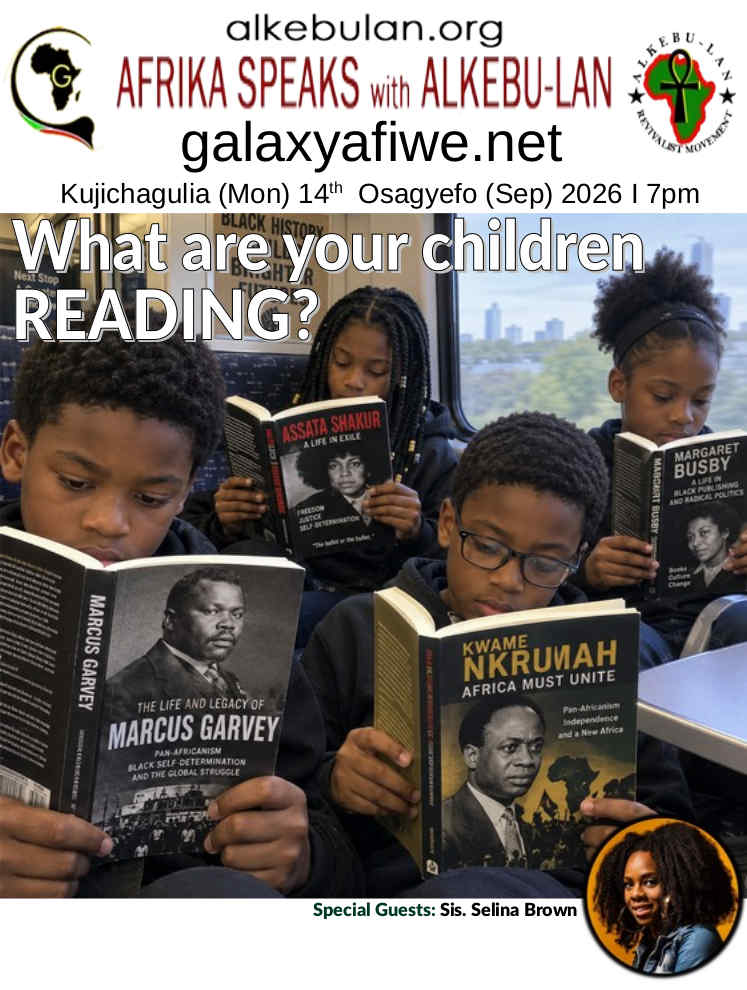
In our previous show we highlighted the invaluable work that foundation schools have performed in the Afrikan community for several decades. Over the years these institutions have been a confluence of committed parents, Sebas (teachers) and of course children. (1)
From the earliest days it was recognised that resources would be needed to complement the growing black consciousness, particularly books and a Black books industry began to develop and these publications began staple fixtures in foundation schools. Demand grew to the extent that publishers, book sellers, distributors and activists like John la Rose and Eric & Jessica Huntley came together to establish the The International Book Fair of Radical Black and Third World Books that ran from 1982 to 1995. (2)
So whereas attendees of foundation schools had access to these literary assets, those that didn’t, by far the majority, did not. Indeed, such resources are still being fought against in mainstream schools to the detriment of Afrikan children. (3) This is because “students who see themselves reflected in the books they’re reading are typically more engaged and curious about different things they can learn from a book.” (4)
There was always a fightback but this has intensified in recent years through organisations like The Black Curriculum, founded in 2019 as “an education campaign… to get black British history embedded in the national curriculum and taught in schools in England year-round, as an alternative to the limitation of Black History Month.” (5)
Through initiatives like The Black British Book Festival (BBBF), this thrust has extended beyond educational institutions and into the community at large.
“BBBF is Europe’s largest Black literature festival and a leading cultural organisation championing Black British books, writers and readers. Founded in 2021, BBBF has grown into a powerful year-round platform working across publishing, education, libraries, prisons, festivals and communities. We create opportunities for Black writers, connect readers with books that reflect their experiences, and work with some of the UK’s biggest publishers and cultural institutions.” (6)
BBBF’s driving ambition is “to make Black British literature more visible, more valued and more accessible — and to build lasting cultural infrastructure for generations to come.” (7)
The importance of this cannot be understated, feeding in to what education strategist and author Bro. Neil Mayers calls “cultural esteem… a psychological fortress built from accurate knowledge of one’s heritage. It’s the framework that dictates how a child sees themselves, what they aspire to, and ultimately what they believe they’re entitled to achieve.” (8)
The current political climate in the UK renders this non-negotiable for Afrikan people and events like The Black British Book Festival and their related activities make it bit more accessible – as long as we make use of the resources we are accessing.
(1) Afrika Speaks with Alkebu-Lan on Galaxy Radio (07/09/26) How do we Educate to Liberate? https://alkebulan.org/aswag-605-how-do-we-educate-to-liberate/;Kehinde Andrews (22/06/18) The Black Studies Movement in Britain. https://www.aaihs.org/the-black-studies-movement-in-britain/
(2) Margaret Andrews (2013) Doing nothing is not an option: The radical lives of Eric & Jessica Huntley. Krik Krac. p. 113; Tiffany Florvil (26/06/19) On The International Book Fair of Radical Black and Third World Books. https://www.aaihs.org/on-the-international-book-fair-of-radical-black-and-third-world-books/
(3) Nadine White (28/03/26) Black writers’ books pulled from UK school library amid censorship row as author speaks out. https://www.blackcurrentnews.co.uk/p/nova-reid-black-authors-books-removed-uk-school; Sinai Fleary (11/10/22) More black books please. https://www.voice-online.co.uk/news/features-news/2022/10/11/more-black-books-please/; Dr Jason Arday (Eds. Edited by: lisa kennedy, bethany thompson, eleshea williams and melody triumph) (2021) The Black Curriculum: Black British History In The National Curriculum Report 2021. https://niromp.org/wp-content/uploads/2020/11/19588-tbc2021report.pdf. p. 6
(4) MAYA POTTIGER (28/07/22) Here’s Why Black Kids Need Black Books. https://amsterdamnews.com/news/2022/07/28/heres-why-black-kids-need-black-books/
(5) Afrika Speaks with Alkebu-Lan on Galaxy Radio (10/02/20) Is history “best qualified to reward our research”? https://www.alkebulan.org/2020/02/10/aswag-266-omx-history-qualified/
(6) Black British Book Festival (2026) About Black British Book Festival. https://blackbritishbookfestival.com/about-us/
(7) Ibid.
(8) Neil Mayers (2026) The Lie We Call School: Why the System Isn’t Broken, and Why That’s the Problem. ill-Literation. p.132.
we ask the question:
How do we Educate to Liberate?
1) Do you have a home library for your children?
2) How much Black literature do your children access in school?
3) Do events like BBBF indicate a growing appetite for Black literature?
4) How should approach instilling cultural esteem?
Our Special Guest:
Sis. Selina Brown: is an award-winning author, cultural leader and Founder & CEO of the Black British Book Festival, Europe’s largest Black literature festival. Since launching BBBF in 2021, she has grown it into a major cultural platform working across publishing, education and communities. Sis. Selina is also a Penguin Random House children’s author and recipient of the Queen’s Reading Room National Reading Hero Medal, recognised for her contribution to books, reading and representation.
*******
Apologise and hold inquiry into ESN schools in the 1950s to 1980s: https://petition.parliament.uk/petitions/769015
Set up an independent inquiry into West Indian children placed in ESN schools: https://petition.parliament.uk/petitions/760415
Support the T21 Alchemy campaign: https://www.gofundme.com/f/t21-alchemy-raising-consciousness-around-around-disability
Support the Black Child Down Syndrome Project: https://blackchilddownsyndrome.com/about-us/
Afrika Speaks Archive: https://www.mixcloud.com/AfrikaSpeaks/