
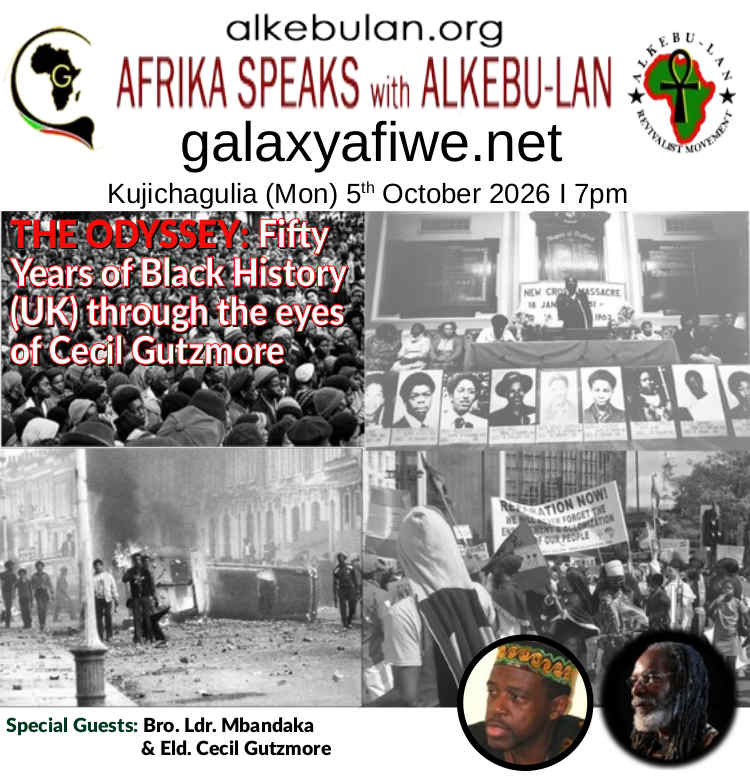
This year is the 39th anniversary of Black History Month (BHM) in the UK, advanced with a comprehensive vision:
“By the designation of October as Black History Month it is our expectation that “Africa’s ideals”, shall forever be manifested in the upliftment of the African Personality in our schools, institutions of higher learning, communities, borough councils and especially in the hearts, minds and deeds of politicians…promoting positive public images and an understanding of Afrikans and people of Afrikan descent and encourage the positive teaching and development of their history, culture and struggles” and to “support Afrikan organisations and liberation movements based in London.” (1)
The advent of BHM should be seen in context of the social climate of the times that preceded it. White nationalism in the form of groups like the National Front, emboldened by politicians at the highest level became an increasing presence on the streets. (2)
However, it was met head-on with a growing militancy within the Afrikan community. Bernard Coard’s seminal 1971 pamphlet How the West Indian Child Is Made Educationally Subnormal in the British School System: The Scandal of the Black Child in Schools in Britain, shattered the neo-colonial myth that existed for many parents of the UK as a benevolent “mother country.” Mobilised parents created organisations and some of these organisations established youth wings. (3) Alongside this was the growing influence of Rastafari, that: “Gripped the imagination of young Black Britain in ways, and to extent, never known before or since,” making it… “one of the largest and important contributory factors in the cultural making of Black Britain.” (4)
Resistance became manifest through confrontations like 1976 Notting Hill Carnival; the Battle of Lewisham and Africa Liberation Day in 1977; the Bristol Uprising in 1980; the National Black People’s Day of Action in March 1981, largely in response to the New Cross Massacre of January of that year; the Brixton Uprising the following month and the Broadwater Farm uprising in October 1985. (5)
This movement impacted every aspect of Afrikan life including the politics, the music, the arts including musicians like Ras Messengers, Ras Angels and Ankh Anum, visual artists like Keith Piper, Eddie Chambers and Sonia Boyce. Many of these threads were brought together by film maker Menelik Shabazz and the Ceddo collective.(6)
All of this created sufficient cultural capital to designate Afrikan Jubilee Year in 1987/88: to commemorate the centenary of the birth of the Most Eminent Prophet & King, His Excellency – Marcus Mosiah Garvey, to commemorate the 25th anniversary of the founding of the Organisation of Afrikan Unity, and to observe the 150th anniversary of emancipation in the Caribbean. (7)
Today many regard BHM with disdain and see it as something within the gift of local authorities to confer or deny. (8) Such a perspective betrays the original vision and our capacity to take charge of the observance for our own ends. (9)
Perhaps the main unresolved issue in this odyssey of Black History in the UK is the failure to establish a functional national representative organisation. The potential was there following the National Black People’s Day of Action in 1981 but it turned not to be the case. Three decades later the interim National Afrikan People’s Parliament showed great promise until its untimely implosion. The mantle has now been taken up by the Pan-Afrikan People’s Parliament with the challenge of utilising this rich history to create an indelible lasting legacy at time when many of the oppositional tendencies in UK society are resurgent. (10)
1) Akyaaba Addai-Sebo and Ansel Wong (Eds) (1988) Our Story – A Handbook of African History and Contemporary Issues. London Strategic Poverty Unit p. 6-8
(2) John Heywood (19/03/24) Rise and fall: The National Front, football hooliganism, and skinhead culture in Britain in the 1970s. https://yorkshirebylines.co.uk/politics/rise-and-fall-the-national-front-football-hooliganism-and-skinhead-culture-in-britain-in-the-1970s/; Daniel Trilling (10/04/13) Thatcher: the PM who brought racism in from the cold. https://www.versobooks.com/en-gb/blogs/news/1282-thatcher-the-pm-who-brought-racism-in-from-the-cold?srsltid=AU7gw4Wsx_a3BVr1qXKr3ecRJs8H2gJZv85eF9UcRjzBACjWTat6cu-D
(3) Winston Trew (2010) Black For A Cause… Not Just Because.. The case of the ‘Oval4’ and the story of Black Power in 1970s Britain. Trew Books. p. 184-5. For example, a group of Jamaican Garveyites founded SELPO (South East London Parents Organisation) and created a youth wing called Fasimba, which included member of the “Oval Four.”
(4) Eddie Chambers (2017) Roots & Culture: Cultural Politics in The Making Of Black Britain. Bloomsbury Visual Arts. p. 84, p. 100
(5) Jessica White (31/08/20) Police, Press & Race in the Notting Hill Carnival ‘Disturbances.’ https://www.historyworkshop.org.uk/black-history/notting-hill-carnival-disturbances/; Karin Andreasson (25/06/14) Vanley Burke’s best shot: African Liberation Day in Birmingham, 1977. https://www.theguardian.com/artanddesign/2014/jun/25/vanley-burke-my-best-shot-photography-birmingham-1977; Mark Townsend (13/08/17) How the battle of Lewisham helped to halt the rise of Britain’s far right. https://www.theguardian.com/uk-news/2017/aug/13/battle-of-lewisham-national-front-1977-far-right-london-police.; Steve Mellen (02/04/20) St Pauls riots in Bristol remembered 40 years on. https://www.bbc.co.uk/news/uk-england-bristol-52105853; Perry Blankson (11/04/23) The Great Insurrection: Remembering the Brixton Uprising. https://tribunemag.co.uk/2023/04/the-great-insurrection-remembering-the-brixton-uprising; Angela Cobbinah (10/09/21) Rightful indignation. https://www.islingtontribune.co.uk/article/rightful-indignation
(6) Robbie Shilliam (18/07/13) Pacific Redemption Songs. https://thedisorderofthings.com/tag/ras-messengers/; Yasmina Price (04/08/21) Rest in Power, Menelik Shabazz. Black British Cinema Is All the Better in Your Wake. https://hyperallergic.com/rest-in-power-menelik-shabazz-black-british-cinema-better-in-your-wake/
(7) Addai-Sebo and Wong. p. 319.
(8) Conaill Corner (02/10/26) St Helens Council will not observe Black History Month. https://www.sthelensstar.co.uk/news/26600952.st-helens-council-will-not-observe-black-history-month/
(9) Afrika Speaks with Alkebu-Lan on Galaxy Radio (13/10/25) How do we revive the vision of BLACK HISTORY MONTH? Pt. 2. https://alkebulan.org/2025/10/13/aswag-557-how-do-we-revive-the-vision-of-bhm-pt2/
(10) Douglas James (25/02/26) How Did We Get From Far-Right Nazi Skinheads to Reform UK? https://dorseteye.com/how-did-we-get-from-far-right-nazi-skinheads-to-reform-uk/
we ask the question:
The Odyssey: 50 Years of Black History (UK) through the eyes of Cecil Gutzmore
1) What were main drivers of political activism in the 1970s?
2) What role did Rastafari play raising awareness?
3) How did arts and culture shape the consciousness of the community?
4) How should the last fifty years shape our activism today?
Our Special Guests:
Bro. Ldr. Mbandaka: Resident guest who is Spiritual Leader of the Alkebu-Lan Revivalist Movement and an Afrikan-Centred Education Consultant. Bro. Ldr is a veteran activist of over 40 years standing, a featured columnist in The Whirlwind newspaper and author of Mosiah Daily Affirmations and Education: An African-Centred Approach To Excellence.
Eld. Cecil Gutzmore: is an internationally renowned veteran scholar and activist who has been active in the Pan-Afrikan community for over fifty years. He migrated to the UK in 1961 later spending a decade back in Jamaica. Has been student, factory worker, clerical worker, community worker, local government and freelance training and management consultant and university lecturer in London and at UWI, Mona, Jamaica. His activism combines Black and left class positions.
Eld. Cecil’s writings on history, philosophy of science and political science and cultural studies have appeared in The Black Liberator, Marxism Today, Race and Class and Interventions; as well as various book chapters, newspaper columns and reviews in The Guardian (UK) The Jamaica Gleaner, The Morning Star and other newspapers. His research interests including the visual history of Africa and her Diasporas has led to the production of a number of photo-history exhibitions dealing with Caribbean Women and Marcus Mosiah Garvey amongst others. Eld. Cecil has also worked on some of the films of Menelik Shabazz.
*******
Apologise and hold inquiry into ESN schools in the 1950s to 1980s: https://petition.parliament.uk/petitions/769015
Support the T21 Alchemy campaign: https://www.gofundme.com/f/t21-alchemy-raising-consciousness-around-around-disability
Support the Black Child Down Syndrome Project: https://blackchilddownsyndrome.com/about-us/
Afrika Speaks Archive: https://www.mixcloud.com/AfrikaSpeaks/