
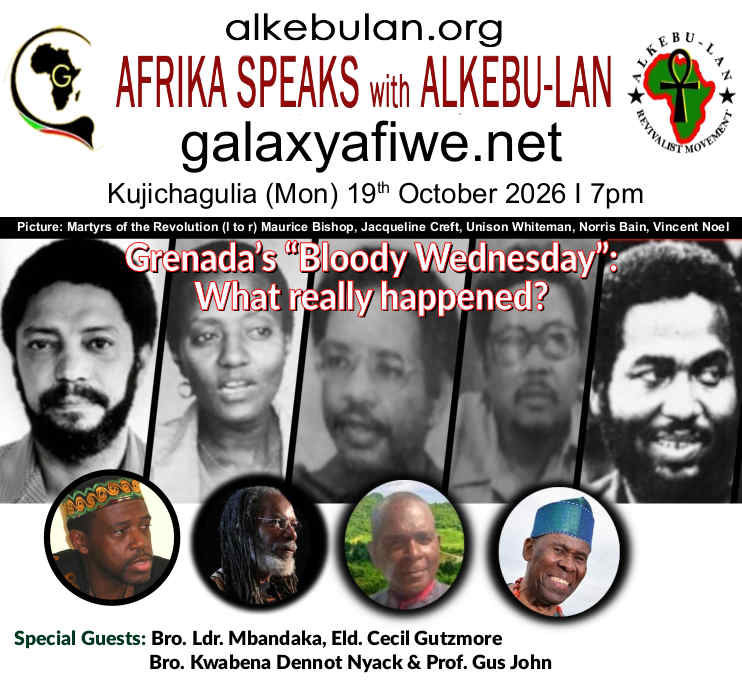
October 19th 1983 is seen by many as the date the fledgeling revolution Grenada died, following the implosion of the People’s Revolutionary Government.
Following its seizure of power in a bloodless coup on March 13th 1979, the new administration quickly transformed the country.
2.1% to 5.5% increase in the economy (1979-1982) against a backdrop of a worldwide recession; transformation from an importer to an exporter of fish; electricity to rural areas for the first time; reduction of unemployment from 49% to 14%; establishing free health care; a housing repair scheme that benefited 17,000 families; increase in school leaving exam pass rate from 3% to 32% (1978-1982); first new government secondary school built in 100 years; halving then abolishing school fees; extensive teacher training programme and reduction of illiteracy from 20% to 3%. (1)
Many of the facts of October 19th are not in dispute, although some are subject to different interpretations while others have been the subject of fierce debate and even recriminations ever since. We have dealt with much of this is a previous show so will only summarise here. (2)
On October 12th 1983 Prime Minister Maurice Bishop was placed under house arrest ostensibly for reneging on a previous agreement for joint leadership of the party alongside Bernard Coard. News of the house arrest did not become public knowledge for a week but when it did, the people resolved to free “we leader” which they did on the morning of the 19th. He was ultimately taken to Fort Rupert. The army was dispatched to re-take the installation. (3)
From here things get more contentious. There were reports of the crowd firing on and killing soldiers provoking an angry response resulting in the Prime Minister, other cabinet members and associates being detained. We do know that shortly after 1p.m. a firiing squad consisting of Andy Mitchell, Vincent Joseph and Cosmos Richardson and under the direction of Callistus Bernard proceeded to execute Maurice Bishop, his pregnant partner Minister of Education Jacqueline Creft, Foreign Minister Unison Whiteman, Housing Minister Norris Bain, Labour leaders Vincent Noel and Fitzroy Bain and other supporters including Keith “Pump Head” Hayling, Evelyn “Bratt” Bullen, Evelyn Maitland, Andy Sebastian Alexander, Nelson Steele, Simon Alexander, Avis Ferguson, Alleyne Romain, Eric Dumont and Gemma Belmar. People’s Revolutionary Army members killed that day included Dorset Peters, are: Raphael Mason, Conrad Mayers, Martin Simon, Franklyn James and Glen Nathan. (4)
The USA had already established a destabilisation campaign and had allegedly infiltrated the orbit around the government if not the government itself. Moreover, the notorious military operation Amber and the Amberines in the summer of 1983 made it clear they were already planning to invade but the implosion gifted them a convenient pretext to launch an offensive on October 25th to crush the revolution and according to some accounts take custody of the bodies. (5)
Two main narratives have emerged as a result of events of 19th October. One posits that an ultra-left (Stalinist) faction of the government led by a jealous Bernard Coard conspired to oust and execute the popular Prime Minister. This is also the version of events largely supported by the USA. (6)
An alternative view is that although there may have been stylistic differences there were no ideological ones. Indeed, Bernard Coard stepped down from the central committee in 1982. The events of October 19th are described as tragic but spontaneous and unplanned while conceding grave mistakes were made. There are also inferences here that Cuba had a destabilising impact. Ultimately, Bernard Coard admitted that the leadership “take moral and political responsibility for what happened.” (7)
Eighteen stood trial for the murder of Maurice Bishop and seven others: Bernard Coard (Deputy Prime Minister/Acting Prime Minister); Hudson Austin (Head of the Army); Dave Bartholomew (Grenadian politician) (Central Committee member); Callistus Bernard (private in charge of the firing squad at Fort Rupert – admitted shooting Bishop); Phyllis Coard (Deputy Minister for Foreign Affairs); Leon Cornwall (Central Committee member); Liam James (Central Committee member); Ewart Layne (General – dispatched Army forces to Fort Rupert); Colville McBarnette (Central Committee member); Cecil Prime (Captain – present at Fort Rupert at the time of the executions); Lester Redhead (Captain – present at Fort Rupert at the time of the executions); elwyn “Sello” Strachan (Central Committee member); Christopher Stroude (Major – present at Fort Rupert at the time of the executions); John Ventour (Captain); Raymond Vincent Joseph; Cosmos Richardson and Andy Mitchell. Seventeen were found guilty and one, Raeburn Nelson acquitted. Fourteen were sentenced to death by hanging which was later commuted to prison terms. Bernard Coard referred to the process as a “kangaroo court.” By September 2009 all had been released from prison. (8)
Decades on it appears that the different factions have been unable to reconcile despite efforts being made over several years reflecting the strength of feeling to this day. Another aspect still seeking resolution is the whereabouts of the remains of those slain on October 19th 1983 with questions being asked of both the USA and UK governments. (9)
1) Steve Cushion & Kwabena Dennot Nyack (2018) By Our Own Hands: A People’s History of the Grenadian Revolution. Cutlass/Caribbean Labour Solidarity. p. 12-27
(2) Afrika Speaks with Alkebu-Lan on Galaxy Radio (29/10/18) Grenada Invasion 35 years on: What are the lessons? https://www.mixcloud.com/AfrikaSpeaks/grenada-invasion-35-years-on-what-are-the-lessons-29102018/
(3) Bhaskar Sunkara (25/10/23) The US invaded the island of Grenada 40 years ago. The legacy of revolution lives on. https://www.theguardian.com/commentisfree/2023/oct/25/the-us-invaded-the-island-of-grenada-40-years-ago-the-legacy-of-revolution-lives-on
(4) Atiba L. Rougier (22/11/16) What Do You Do with a Massacre? Https://publicseminar.org/2016/11/what-do-you-do-with-a-massacre/; Al Rougier (15/10/16) 19th october, 1983: as the crows fly above… https://www.bigdrumnation.com/2016/10/18/19th-october-1983-as-the-crows-fly-above/
(5) Danny Shaw (25/10/21) 38 Years After a Triple Assassination, Grenada’s Short-Lived Revolution Still Inspires. https://towardfreedom.org/story/archives/americas/38-years-after-a-triple-assassination-grenadas-short-lived-revolution-still-inspires/; Noreen & Alan Scott (2020) Timeline. Committee for Human Rights in Grenada UK in association with Caribbean Labour Solidarity and Grenada Forward Ever. p. 1. https://grenada-forwardever.net/wp-content/uploads/2024/11/2023-10-29-Timeline-of-events-in-October-1983.pdf; Oliver Jones (11/12/23) UK meeting draws lessons from Grenada Revolution. https://themilitant.com/2023/12/02/uk-meeting-draws-lessons-from-grenada-revolution/
(6) The New Today (12/02/22) The order to kill Maurice Bishop. https://www.thenewtodaygrenada.com/local-news/the-order-to-kill-maurice-bishop/;
(7) Debbie Quain (20/03/19) The Grenada Revo Story, Part 2. https://grenadarevo.com/grenada-revo-02/; Afrika Speaks with Alkebu-Lan on Galaxy Radio. Op. cit.; Raoul Pantin (05/02/22) Exclusive interview with Bernard Coard. https://web.archive.org/web/20131027205406/http://www.trinidadexpress.com/news/Exclusive_interview_with_Bernard_Coard-115360229.html
(8) new york times (05/12/86) 14 Sentenced To Death In Grenada In 1983 Killing Of Prime Minister. https://www.nytimes.com/1986/12/05/world/14-sentenced-to-death-in-grenada-in-1983-killing-of-prime-minister.html; BBC News (07/09/09) Last of “Grenada 17” released. https://www.bbc.co.uk/webarchive/https%3A%2F%2Fwww.bbc.co.uk%2Fcaribbean%2Fnews%2Fstory%2F2009%2F09%2F090907_grenada_release.shtml
(9) The New Today (22/10/22) Warring revolutionary sides still miles apart. https://www.thenewtodaygrenada.com/local-news/warring-revolutionary-sides-still-miles-apart/
(10) Scott & Scott. Op. cit.; Sinai Fleary (31/10/22) Grenada creates public holiday to commemorate ex-PM Maurice Bishop and asks UK to provide information on the whereabouts of his remains. https://www.voice-online.co.uk/news/world-news/2022/10/31/grenada-to-make-october-19-a-public-holiday-from-2023/; Rougier. Op. cit.
we ask the question:
Grenada’s “Bloody Wednesday”: What really happened?
1) How has the USA influenced the narrative around October 19th 1983?
2) How do we make sense of the different accounts of events on the day?
3) Is reconcilliation possible or positions too entrenched?
4) Will we ever see anything like the Grenada Revolution in the region again?
Our Special Guests:
Bro. Ldr. Mbandaka: Resident guest who is Spiritual Leader of the Alkebu-Lan Revivalist Movement and an Afrikan-Centred Education Consultant. Bro. Ldr is a veteran activist of over 40 years standing, a featured columnist in The Whirlwind newspaper and author of Mosiah Daily Affirmations and Education: An African-Centred Approach To Excellence.
Eld. Cecil Gutzmore: is an internationally renowned veteran scholar and activist who has been active in the Pan-Afrikan community for over fifty years. He migrated to the UK in 1961 later spending a decade back in Jamaica. Has been student, factory worker, clerical worker, community worker, local government and freelance training and management consultant and university lecturer in London and at UWI, Mona, Jamaica. His activism combines Black and left class positions.
Eld. Cecil’s writings on history, philosophy of science and political science and cultural studies have appeared in The Black Liberator, Marxism Today, Race and Class and Interventions; as well as various book chapters, newspaper columns and reviews in The Guardian (UK) The Jamaica Gleaner, The Morning Star and other newspapers. His research interests including the visual history of Africa and her Diasporas has led to the production of a number of photo-history exhibitions dealing with Caribbean Women and Marcus Mosiah Garvey amongst others. Eld. Cecil has also worked on some of the films of Menelik Shabazz.
Bro. Kwabena Dennot Nyack: is a campaigner, trade union organiser and equalities practitioner whose approach to reparations draws on a lifetime of engagement with Caribbean politics, racial equality and social justice. He argues that confronting the legacies of slavery and colonialism must go hand in hand with accountability for leadership and decisions today.
Born in Grenada, Kwabena came to Britain in 1960 as part of the Windrush migration. After leaving school with few qualifications, he returned to education and gained a law degree at the Polytechnic of Central London. His experience of migration and unequal opportunities helped shape his political outlook.
A return visit to Grenada in 1972 prompted him to question why people with similar abilities faced such different prospects. He subsequently joined Cause for Concern, supporting the movement that helped bring about the Grenada Revolution. Following the Revolution, he undertook political and communications work the People’s Revolutionary Government’s High Commission to the UK.
The Revolution’s collapse and Maurice Bishop’s killing brought disillusionment but did not end his commitment. He campaigned against the execution of the Grenada 17, supported their release and has campaigned for the return of Bishop’s remains.
His work in Britain has included equalities roles in local government, the charitable sector and the University of Reading, alongside assessing councils’ equality and diversity practices. As Chair of the Fanon Trust, an African and African-Caribbean mental health charity, he helped strengthen governance and secure service users’ representation on its board. He also chaired a youth and community association and served as a school governor.
After taking up private hire driving, following his retirement, Kwabena joined the GMB in 2017, became one of the organisers for Uber drivers and supported their struggle for employment rights.
These experiences inform his contribution to the discussion of reparations: historical injustice has continuing consequences, while principles must translate into practical improvements in people’s lives. He brings a questioning perspective to the debate, insisting that demands for historical justice must never shield present-day failures from scrutiny.
For Kwabena, reparations and accountability belong in the same conversation.
Prof. Gus John: is an education campaigner, author and was the first black Director of Education in Britain in 1989. Since the 1960s, he has spent his entire career campaigning against racial discrimination and issues within the education sector in Britain’s inner cities. Born in Grenada, he moved to the UK to study at Oxford, where his passion for education and youth development came alive. Gus became a community activist and worked with youth groups in Manchester, campaigning for issues such as employment opportunities for black school leavers.
In his long and successful career, Gus has been a member of numerous teaching unions and education authorities and has worked as an education consultant across the world, fighting for equality and justice, whilst empowering young people. In 1999, Gus John co-founded the Communities Empowerment Network (CEN), a charitable organisation providing representation for excluded school students and their parents/carers.
In the same year, Gus was offered a CBE in the New Year Honours list but declined. He explained at the time that his career in the UK had always been about the struggle for racial equality and social justice. One of the major stumbling blocks of promoting racial equality is the legacy of the British Empire, therefore he believed it a serious dishonour to be a Commander of the institution he had tried to demolish.
*******
Remembering Brother Errol: https://www.youtube.com/watch?v=ScGKgGOru8M
Apologise and hold inquiry into ESN schools in the 1950s to 1980s: https://petition.parliament.uk/petitions/769015
Support the T21 Alchemy campaign: https://www.gofundme.com/f/t21-alchemy-raising-consciousness-around-around-disability
Support the Black Child Down Syndrome Project: https://blackchilddownsyndrome.com/about-us/
Afrika Speaks Archive: https://www.mixcloud.com/AfrikaSpeaks/